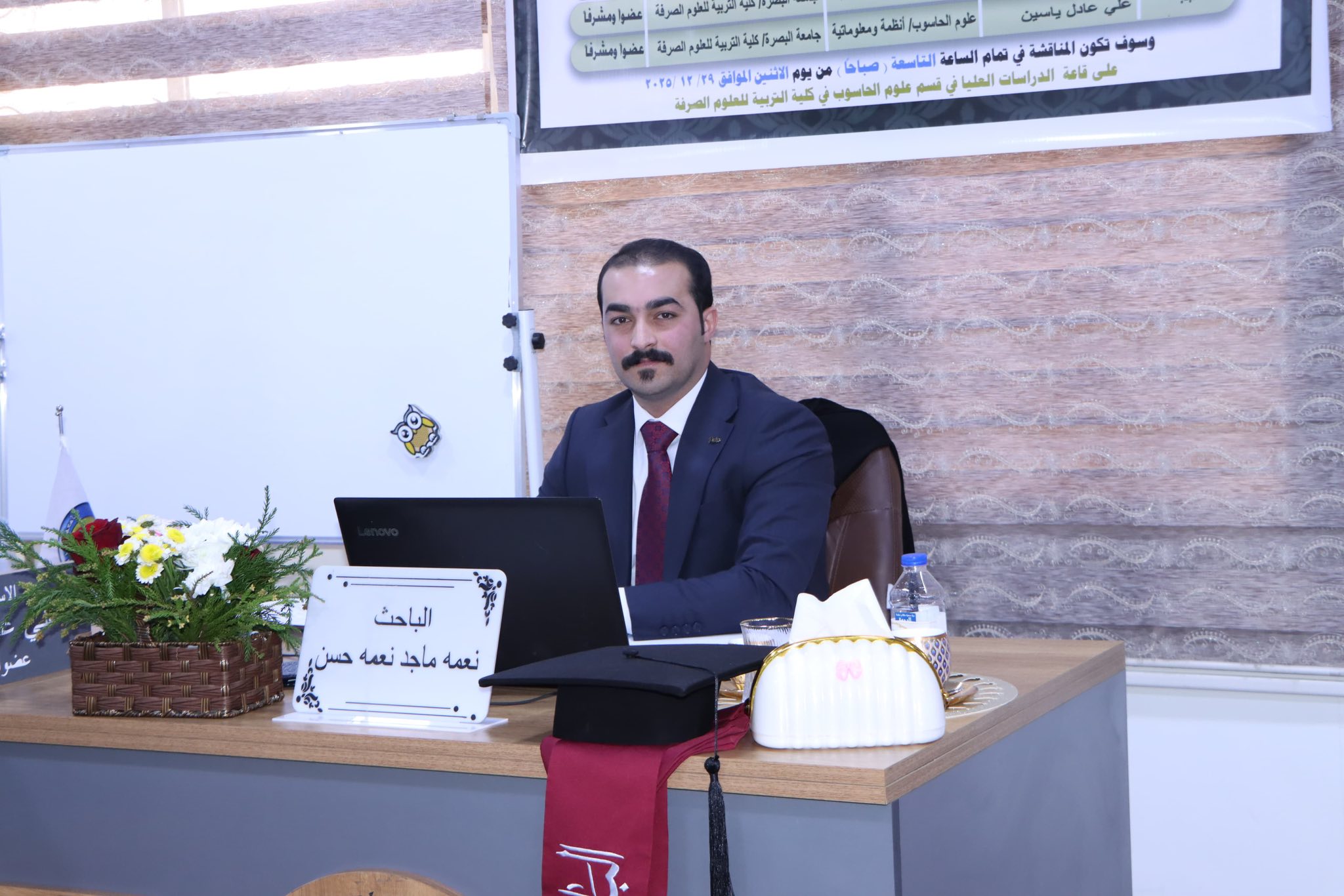
The College of Education for Pure Sciences, Department of Computer Science, reviewed a master's thesis on building a robust authentication and verification scheme in a VANET environment using blockchain. The thesis, submitted by researcher Na'ma Majid Na'ma, addressed the security of intelligent vehicle networks (VANETs) in environments integrated with health IoT systems, focusing on the security challenges associated with linking a vehicle driver's identity to the vehicle itself. Weak authentication mechanisms in this type of dynamic network expose sensitive health data to serious security risks, such as identity spoofing or data tampering.
The researcher explored two advanced security authentication schemes aimed at enhancing data protection and ensuring reliable communication between vehicles and the infrastructure. The first scheme relies on biometric verification and a virtual smart card to securely link the vehicle owner's identity to the vehicle, employing blockchain technology to enhance trust and prevent tampering in the authentication process. The second scheme was developed as a more advanced extension of the first, adopting two-factor authentication and fog computing supported by searchable encryption. This provides a higher level of security and privacy and ensures continuous authentication while vehicles are in motion.
The analysis showed that the proposed system achieves an effective balance between computational and communication costs, along with a high degree of resistance to common security attacks. This makes it a practical and applicable solution for future smart environments in the transportation and healthcare sectors
 .
.
Important News


viewed most