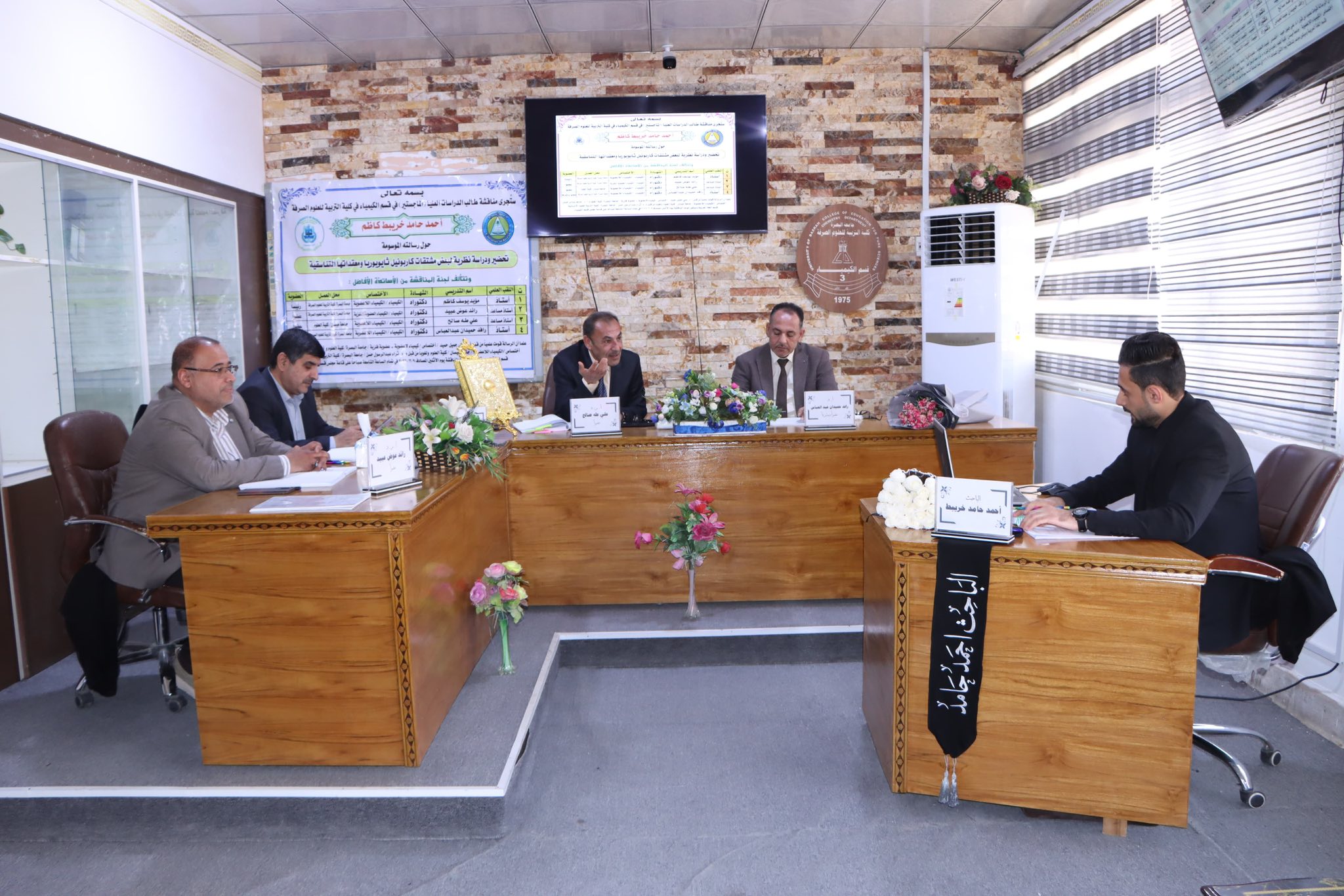
The College of Education for Pure Sciences, Department of Chemistry, conducted a master's thesis on the preparation and computational study of some carbonyl thiourea derivatives and their coordination complexes with cobalt(II) and ruthenium(II) ions. The thesis, submitted by researcher Ahmed Hamed Khuraibat, included three interconnected research axes aimed at exploring the structural, biological, and theoretical properties of a group of ligands derived from 4-nitrobenzoyl thiourea and 4-methoxybenzoyl thiourea and their coordination complexes with cobalt(II) and ruthenium ions. (III)
In the first axis, five organic ligands (L5-L1) were prepared through a two-step synthetic pathway. The first step involved the formation of isothiocyanates from the reaction of 4-nitrobenzoyl chloride or 4-methoxybenzoyl chloride with potassium thiocyanate, followed by the reaction of the resulting product, 4-nitrobenzoyl isothiocyanate or 4-methoxybenzoyl isothiocyanate, with 4,3-dimethylaniline in a molar ratio of (1:1) to form ligands L1 and L2. On the other hand, the benzoyl thiourea diligands L3, L4, and L5 were prepared by reacting 4-benzoyl nitrochloride or 4-benzoyl methoxychloride with 1,1-2,2-diaminebenzene or 1,2-diamineethane in a 1:2 molar ratio. These ligands were used to prepare coordination complexes of cobalt(II) and ruthenium(II) of the benzoyl thiourea derivatives. Ligands L1-L2 were used to prepare cobalt(II) and ruthenium(II) complexes in a 1:2 ligand-metal ratio, while ligands L3-L4 were used to prepare cobalt(II) and ruthenium(II) complexes in a 1:1 ligand-metal ratio. The prepared compounds were characterized using a range of spectroscopic and analytical techniques to confirm their structures, including proton nuclear magnetic resonance spectroscopy. 1H-NMR and 13C-NMR spectroscopy were performed on the ligands, along with infrared (IR) spectroscopy and electron microscopy (EI-MS). Thermogravimetric analysis (TGA), visible and ultraviolet spectroscopy, and electrochemical spectroscopy (ESI-MS) were also conducted on the complexes. Molar conductivity was measured, and magnetic properties were studied to determine the symmetry and geometric structure. Intracellular atomic emission spectroscopy (ICP-AES) was used to calculate the percentages of metals within the complexes. Cyclopotential scanning, a type of electrochemical and dynamical investigation that relies on determining the oxidation state of an element's ion, was also investigated. Cyclopotential scanning of ruthenium complexes in DMSO was performed at room temperature in the range of -2.0 to +1.0 V, using platinum wire and Ag/AgNO3 as the adjacent and source electrodes, respectively, and a supporting electrolyte. [Bu4N][PF6] at a concentration of 0.001 mV and a scanning rate of 1 mV/sec-50 Hz revealed that the ruthenium ion underwent reduction from the Ru(III) oxidation state to the Ru(II) oxidation state. Magnetic susceptibility revealed that the ruthenium complexes exhibited diamagnetic behavior, consistent with the pairing of all electrons resulting from the reduction of the metal ion from Ru3+ to Ru2+. This confirmed that the ruthenium complexes were octahedral low-spin hybridized d2sp3. The cobalt complexes, on the other hand, exhibited paramagnetic properties due to the presence of a single unpaired electron, which explains why the cobalt complexes were octahedral low-spin hybridized sp3d2. Molar conductivity measurements showed that all the complexes were electrolytic in nature and contained ions outside the coordination sphere, except for two complexes: C1 [Co(L1)2(H2O)2].5/2H2O and [Co(L2)2(H2O)2] :C3, whose values (Ω·cm²/M) were 17.6 and 14.9, respectively. Thermal analysis revealed clear thermal stability and the presence of water of crystallization molecules in several of the complexes. Spectroscopic and analytical measurements showed that the prepared ligands acted as donor groups, binding to metal ions via oxygen and sulfur atoms to form hexagonal rings, which contributed to the stability of the complexes.
The second part of the study involved investigating the cytotoxicity of the prepared ligands and complexes to assess their biological activity against breast cancer cells, specifically the MCF-7 cell line, using the MTT assay. The prepared ligands and complexes demonstrated low activity in killing cancer cells.
The results showed that the prepared ligands and complexes exhibited low activity in killing cancer cells. The third axis involved a computational study of the prepared ligands and complexes. Geometry optimization was performed using Gaussian 09 software with the density functional theory (DFT) approach. The B3LYP/6-31G(d,p) basis set was used for the ligands. Quantum calculations included determining bond lengths, angles, Molligan charges, and total energy. The results of the molecular structure calculations for the compounds were consistent with experimental values found in the literature, and the electron density was concentrated on sulfur, oxygen, and nitrogen atoms. Hybrid basis functions were used for the complexes, with the B3LYP/LANL2DZ basis set employed for cobalt (Co) and ruthenium (Ru). Several quantum chemical parameters were calculated, and the geometric structure of the prepared compounds (bond lengths, triangular and quadrilateral angle values) was examined and compared with experimental values. From the literature, it was found that there is a good match between the practical and theoretical values. The values of complexity energy, binding energy, and heat of formation were also calculated to determine the thermal stability of the complexes, as it was found that ruthenium complexes are more stable than cobalt complexes.
Important News



viewed most