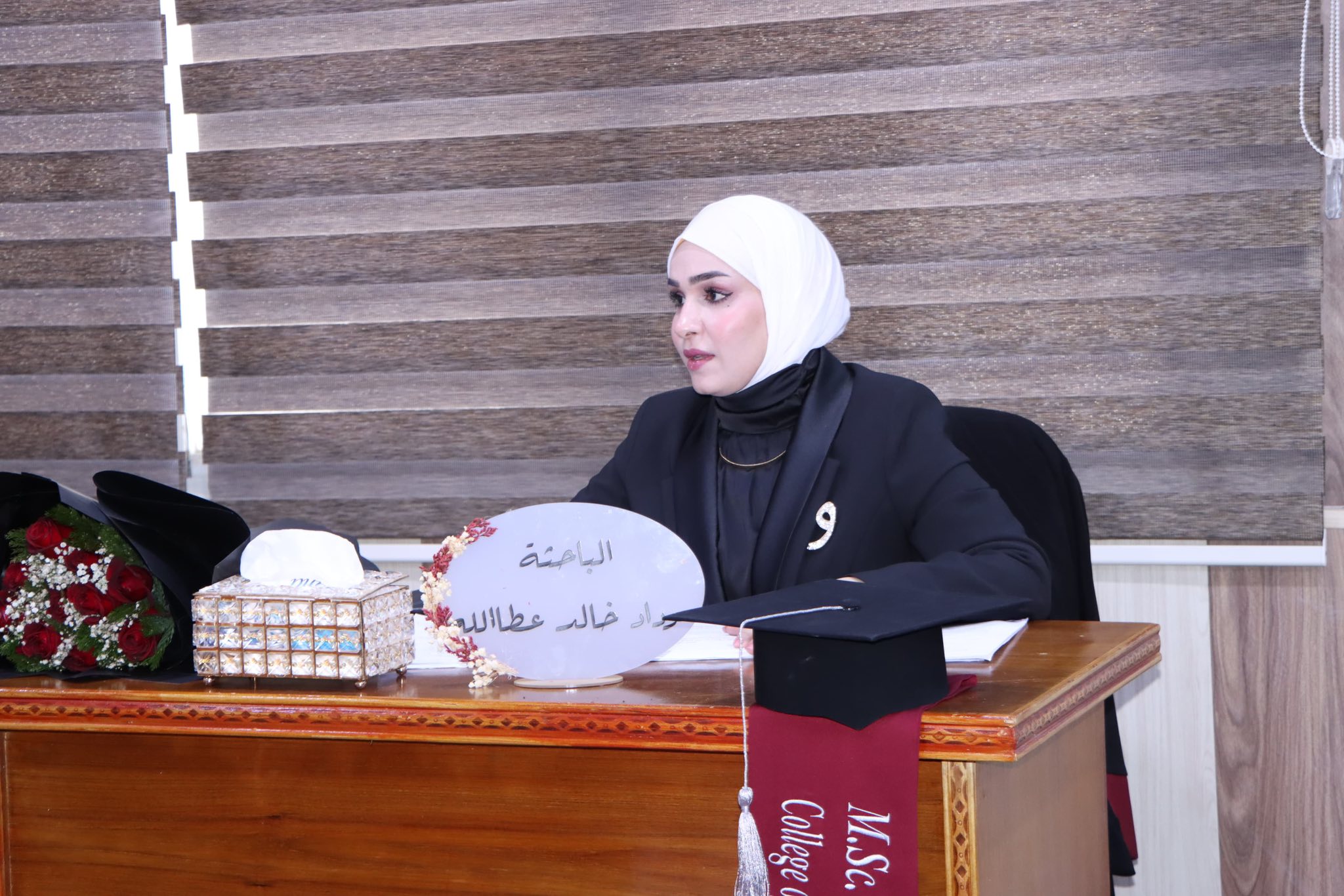
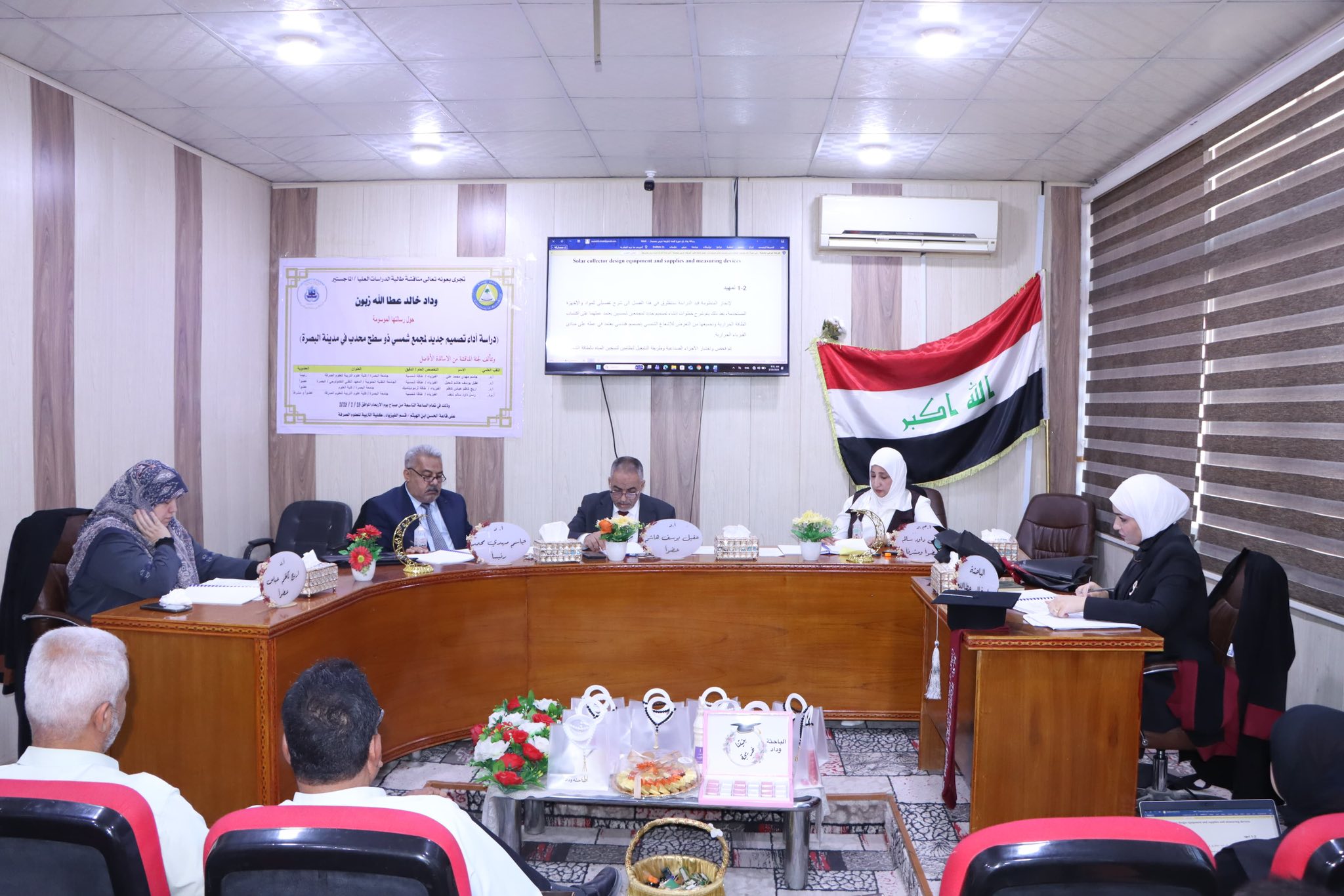
The College of Education for Pure Sciences, Physics Department, reviewed a master's thesis on "A Performance Study of a New Convex Surface Solar Collector Design in Basra City." The thesis, submitted by researcher Wadad Khalid Attallah, included the following: A new geometric design was developed for two solar collectors, Scccs1 and Scccs2, with a corrugated-convex surface to mimic the sun's horizontal movement, increase the angle of solar radiation capture, and incorporate internal tanks for collecting hot water, thus forming a solar system operating with natural circulation. The performance of Scccs1 and Scccs2 was studied and compared under various weather conditions in Basra City. The two designs are geometrically similar.
The thesis also included a performance study of Scccs1 and Scccs2 and a comparison between them. Scccs1 has a direct absorption surface coated in black, while Scccs2 has a reflective absorption surface that directs solar radiation towards the water transfer pipe using surface-mounted mirrors. The black coating enhances the material's heat absorption capacity. The solar collector is integrated with a heat storage system (water tanks installed within the collector A1, A2, B1, and B2). Water is stored and heated using the thermal energy collected from the system's heat acquisition stages.
This system was experimentally evaluated under various loading conditions. The curvature of the system's front surface mimics the sun's horizontal movement during daylight hours, eliminating the need to rotate the solar collector horizontally to align it perpendicular to the sun. The two solar systems, Scccs1 and Scccs2, were proven to operate efficiently in partly cloudy and overcast weather with low temperatures. Depending on daylight hours, solar intensity, air temperature, cloud density, wind speed, and the amount of heat gained or lost in the two solar systems, Scccs1 and Scccs2 recorded the highest water temperatures in partly cloudy weather (Scccs1-Tout = 81°C, tank A2 water = 56°C, and Scccs2-Tout = 70°C, tank B2 water = 50°C). In overcast weather, the water temperatures of Scccs1 and Scccs2 were recorded as follows: (Scccs1-Tout = 54°C, tank A2 water = 34°C, and Scccs2-Tout = 49°C, tank B2 water = 32°C)
 .
.
Important News



viewed most