
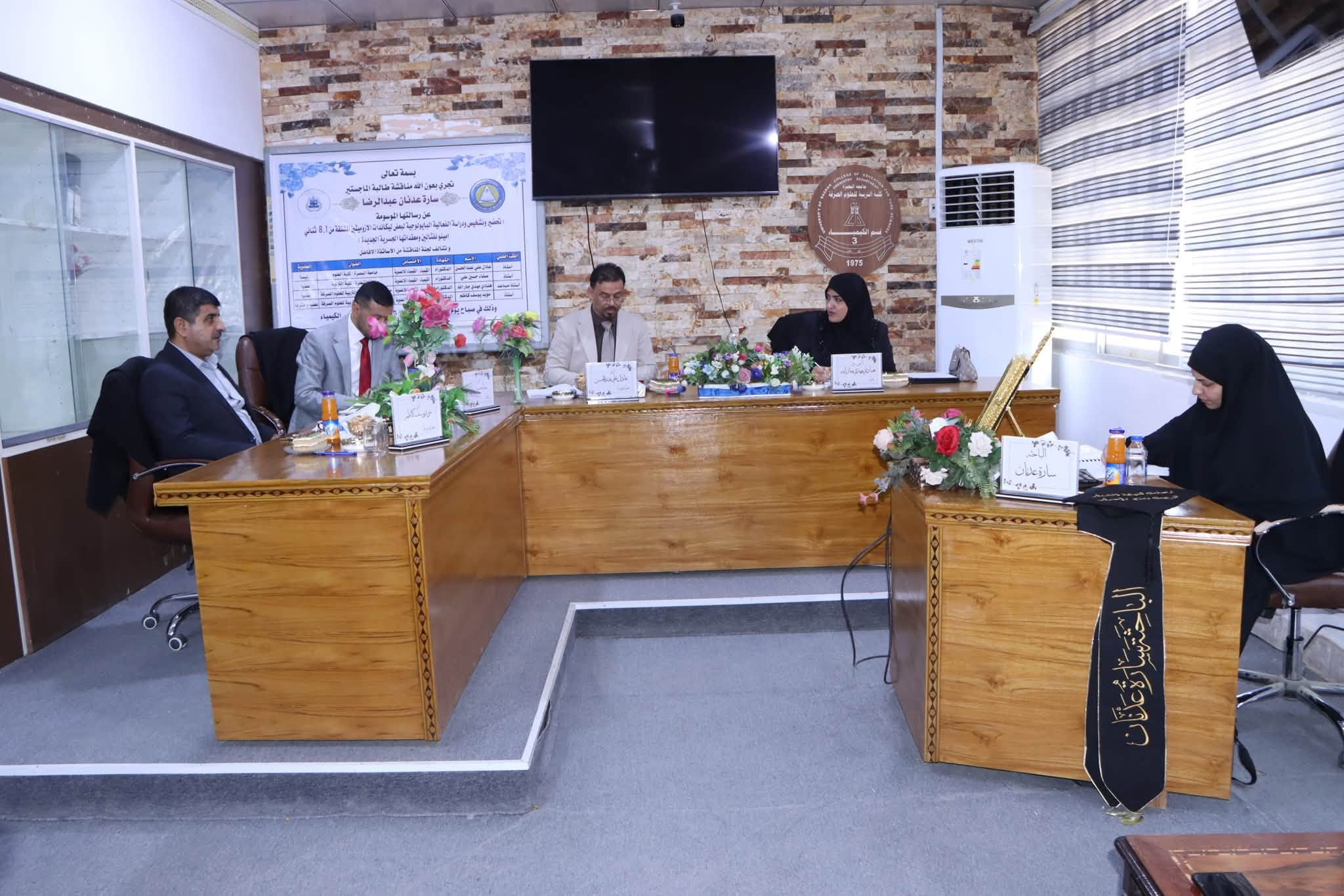
The College of Education for Pure Sciences reviewed a master's thesis in the Chemistry Department on "Preparation, Characterization, and Biological Activity Study of Some Azomethine Ligands Derived from 1,8-Diaminonaphthalene and Their Novel Bridging Complexes." The thesis, presented by researcher Sarah Adnan Abdul-Ridha, aimed to prepare bimetallic tetrathiocyanate complexes of the types [NiCd(SCN)4] and [CoCd(SCN)4] types. This was achieved by first reacting the nitrate of each metal with potassium thiocyanate, followed by reacting the resulting bimetallic tetrathiocyanate compounds with each other in a 1:1 molar ratio. Subsequently, ten bridging thiocyanate complexes containing Schiff bases were prepared by reacting the prepared Schiff base ligands with the bimetallic tetrathiocyanate complexes.
Infrared spectra showed a shift in the amplitude absorption band of the azomethine group in the complexes compared to the free ligands. This study involved the preparation of five Schiff-based bidentate ligands containing an azomethine group, designated L1, L2, L3, L4, and L5. These ligands were prepared by reacting five aldehydes—6-methoxy-2-naphthaldehyde, 4-hydroxybenzaldehyde, N-methylindole-3-carboxyaldehyde, 4-cyanobenzaldehyde, and 4-chlorobenzaldehyde—each with 1,8-diaminonaphthalene in a 1:1 molar ratio. The prepared ligands were characterized using several techniques, including elemental analysis, proton 1H-NMR and carbon-13C NMR spectroscopy, mass spectrometry, and infrared spectroscopy.
The message concluded that the prepared compounds have good efficacy in inhibiting the growth of bacteria and fungi when compared with the standard drugs Ampicillin as an antibacterial and Ketoconazole as an antifungal.
 .
.
Important News


viewed most