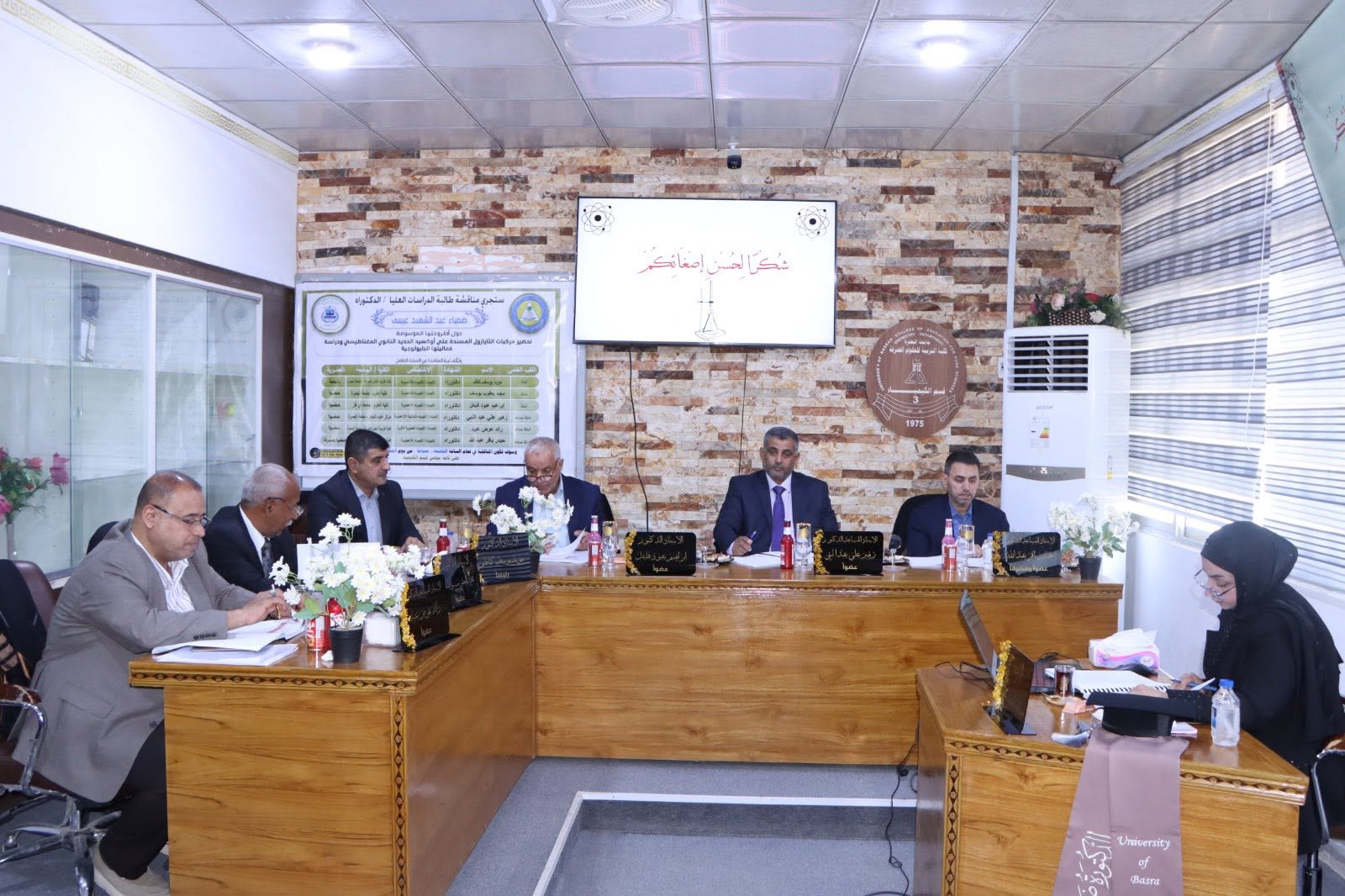
The College of Education for Pure Sciences, Department of Chemistry, reviewed a doctoral dissertation on "Preparation and Characterization of Thiazole Derivatives Based on Magnetic Iron Oxide Nanoparticles and Evaluation of Their Antibacterial Activity." The dissertation, submitted by researcher Dhumia Abdul-Shaheed Issa, aimed to prepare thiazole (T), a heterocyclic compound containing two heteroatoms such as nitrogen and sulfur. It was prepared by reacting aminoacetophenone with iodine and thiourea in the presence of triethylamine as a catalyst and in a suitable solvent such as ethanol. A series of Schiff bases (S1, S2, S3, S4) were derived from the thiazole prepared in the first step by condensing it with a group of aldehydes in a 2:1 ratio in a suitable solvent.
In the second step, magnetic iron nanoparticles (Fe3O4 MNPs) were prepared by the co-precipitation of ferrous iron (Fe⁺²) and ferric iron (Fe+³) in the presence of sodium hydroxide (NaOH) and nitrogen gas (N₂), and coated with citric acid and chitosan. In the final step, the resulting mixture was reacted with thiazole derivatives at concentrations of 0.0001, 0.0002, and 0.0003 M for each of the following (S1, S2, S3, S4) in ethanol via an ionic reaction to form thiazole Schiff base nanoparticles. The prepared compounds were spectroscopically characterized to confirm their proposed chemical structures using infrared (IR) spectroscopy, visible and ultraviolet (V) spectroscopy, mass spectrometry, proton nuclear magnetic resonance (1HNMR) and carbon-13 nuclear magnetic resonance (13CNMR), X-ray diffraction (XRD), optical emission field scanning electron microscopy (FESEM), vibrating sample magnetometry (VSM), and high-resolution transmission electron microscopy (HIEM).
The thesis included:
An ADMET study was used to evaluate the suitability of compounds (T, S4, S3, S2, S1) as potential therapeutic agents. All compounds complied with Lipinski's five-point rule, indicating positive oral bioavailability. Their molecular weights were less than 500 g/mol, and the hydrogen bond donors and acceptors were within acceptable ranges. The calculated polar surface area values remained below the critical threshold of 160 ŲA˚, indicating good membrane permeability. The activity of all prepared compounds was measured against two types of bacteria: Escherichia coli and Staphylococcus aureus. The antibacterial activity exhibited by the Fe3O4-chitosan nanocomposites was measurable against both Staphylococcus aureus and E. coli. The MIC values were mostly 2 μg/ml, while the MBC values consistently exceeded 2 μg/ml across the derivatives. Although there were few differences between the compounds, this suggests that the structural changes induced by Schiff base interactions did not affect the antibacterial properties; rather, the values depend primarily on the properties of the composite material
 .
.
Important News

viewed most