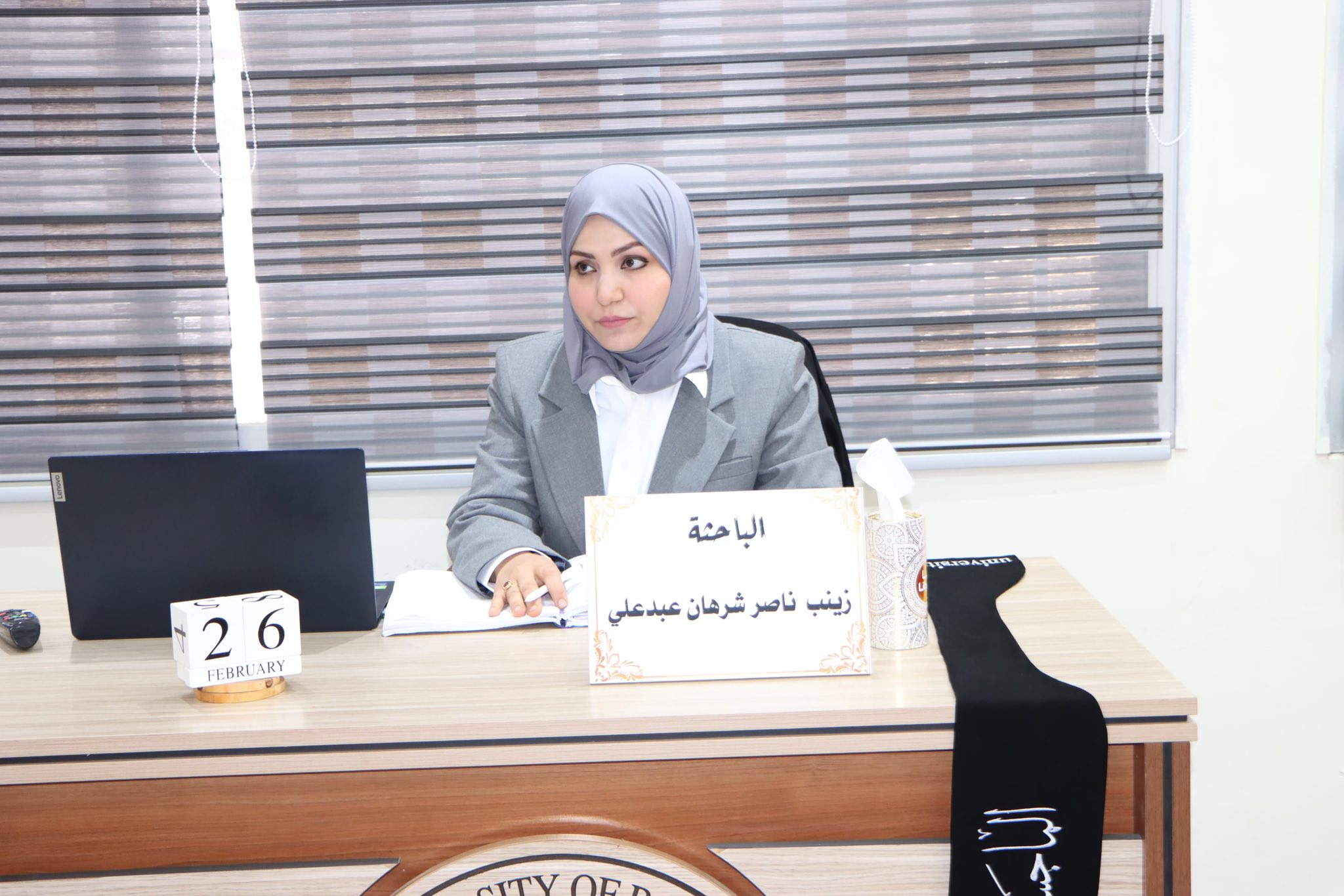
The College of Education for Pure Sciences, Department of Life Sciences, reviewed a master's thesis on "The Relationship Between Inflammatory Response and Some Induced Tissue Factors in Laboratory Rats Injected with Natural Substances (Nanomaterials and Extracts)."
The study, presented by researcher Zainab Nasser Sharhan, aimed to evaluate the analgesic and anti-inflammatory efficacy of both thyme oil and cerium oxide nanoparticles using experimental models of pain and inflammation in laboratory rats. The study included two main experiments: the first investigated the analgesic effect using a formalin-induced pain model in the rat paw. Thirty-six rats were divided into nine experimental groups and administered different treatments, including cerium oxide nanoparticles, thyme oil, and a combination solution of both. Pain intensity was assessed based on the number of paw licks during a 60-minute observation period divided into successive time intervals. The overall response score was used as an indicator of treatment efficacy.
The rats were injected with cerium oxide nanoparticles, thyme oil, and a solution containing both. The second experiment was designed to study the anti-inflammatory effects using a formalin-induced inflammation model (LPS) and a bacterial extract. Sixty male albino rats were divided into acute (less than 7 days) and chronic (28 days) groups to evaluate the protective and therapeutic effects of the studied substances. Treatments were administered at fixed concentrations and volumes, followed by dissection of the animals and collection of liver, kidney, and testicular tissue for histopathological examination. Blood samples were also drawn to obtain serum, and inflammatory markers were measured using a specific technique.
Statistical analysis showed a significant decrease in the intensity of the pain response in the treated groups compared to the positive control group, with a more pronounced effect in the later phase, particularly in the groups treated with cerium oxide nanoparticles, thyme oil, and the combination of both. Analysis of immunological markers showed elevated levels in the LPS group, while the treated groups showed a relative decrease in these levels, without any significant differences between them.
The results showed that the severity of pathological changes was higher in the chronic phase compared to the acute phase, with the appearance of irreversible lesions and clear cellular changes, especially in the liver, which was the most affected organ. Neither thyme oil nor cerium oxide nanoparticles showed sufficient protective effect in liver tissue due to the severity of the inflammatory damage, while a relative improvement was observed in kidney and testicular tissues with a decrease in the severity of tissue damage. The protective effect was more pronounced with treatment using thyme oil compared to cerium oxide nanoparticles, particularly in the acute phase
 .
.
Important News



viewed most