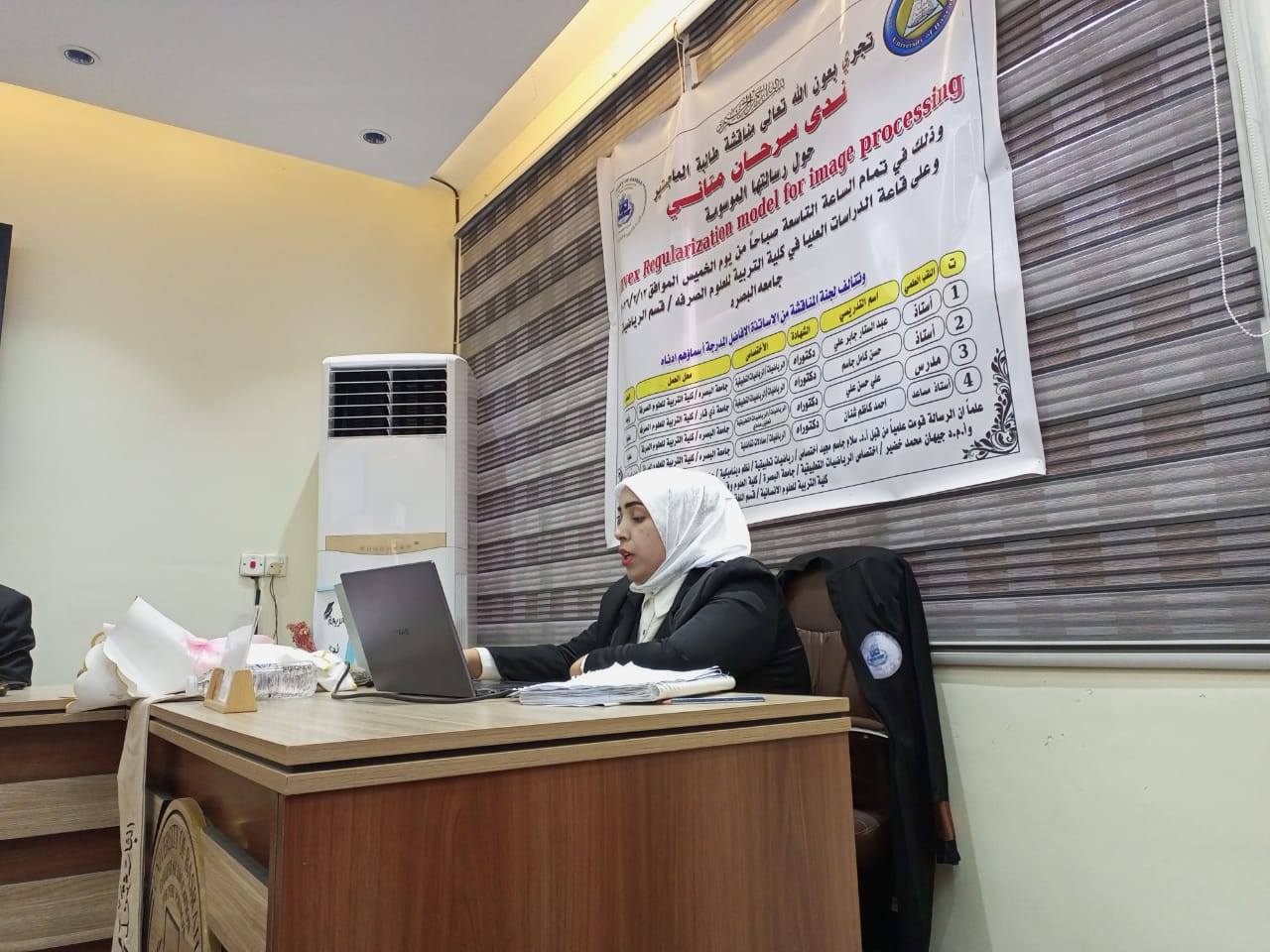
The College of Education for Pure Sciences, Department of Mathematics, reviewed a Master's thesis on a convex organization model for image processing. The thesis, submitted by researcher Nada Sarhan Matani, included:
A study of the concept of convex organization and an analysis of its role in improving image reconstruction. The Cahn-Hilliard equation was used as an applied case study to demonstrate the effectiveness of this organization in restoring lost regions. This efficient and fast fourth-order partial differential equation preserves image structure and smoothness. The applicability of the model in the spatial domain was tested on a range of color spaces, such as HSV, XYZ, NTSC, RGB, YCbCr, YUV, and others.
The model demonstrated its ability to restore lost regions with a high degree of numerical stability, relying on the implicit finite difference method and convex segmentation techniques, thus achieving accurate and stable reconstruction.
Furthermore, a hybrid framework was developed combining the Cahn-Hilliard model with a single-level waveform transformation in the frequency domain. The image was analyzed into different frequency components to leverage wave properties for more efficient texture reconstruction and structural information transmission. This combination of propagation and wave transformation helps preserve fine details and sharp edges, while also reducing optical distortions and improving processing speed.
A comparison of spatial and frequency-based applications shows that the wave-based hybrid framework achieves higher restoration accuracy and delivers superior performance when processing images with small, complex missing areas. Furthermore, this framework enhances the preservation of original edges and structural details.
The results also confirm the flexibility and applicability of this model and provide practical guidance for selecting the appropriate color space and wave type for modern restoration tasks. This study thus represents a significant contribution to the development of digital restoration techniques and provides a scientific foundation for future applications in advanced fields
 .
.
Important News



viewed most