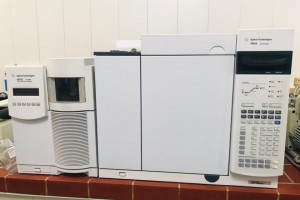
A research team from the College of Education for Pure Sciences/Department of Chemistry published a scientific paper in the Indonesian International Journal. The team consisted of professors and master's students:
Zainab Hashim Mankhi
Prof. Dr. Mahmoud Shaker Hussein
Assistant Professor Dr. Hanan Murtadha Ali
The study concluded that:
A new double Schiff base was prepared by condensing benzidine with 4-hydroxybenzaldehyde. The resulting precursor then underwent condensation polymerization with phthalic and terephthalic acids in the presence of zinc chloride (ZnCl₂) as a catalyst, resulting in the formation of two distinct polymers designated P1 and P2. The molecular structure of both P1 (derived from phthalic acid) and P2 (derived from terephthalic acid) was accurately confirmed using Fourier transform infrared spectroscopy (FTIR) [18, 24]. The spectra clearly showed a strong tensile vibration of the imine (C=N) bond at approximately 1645 cm⁻¹, and the appearance of new ester or amide carbonyl bands in the 1710–1720 cm⁻¹ region after polymerization.
Thermogravimetric analysis (TGA) results indicated that both polymers decompose mainly in two stages, but polymer P2 exhibited significantly higher thermal stability, beginning decomposition at approximately 300 °C, compared to P1 [1, 3, 18]. This superior stability is attributed to the rigid and linear nature of the main chain in P2.
The anticancer activity of both P1 and P2 against human breast cancer cells (MCF-7) was evaluated using the MTT cell viability assay. The results showed that both polymers possess dose-dependent cytotoxicity. It is noteworthy that polymer P2 was more potent, registering an inhibitory half-life (IC₅₀) of approximately 138 μg/ml, while the IC₅₀ for polymer P1 was around 173 μg/ml. These values fall within the previously reported range (120–200 μg/ml) for several similar Schiff base polymers studied by researchers at the University of Basrah [1, 5].
The higher potency of polymer P2 can be explained by its more flattened structure resulting from the terephthalate units, which may contribute to increased cellular uptake or bioactivity [7, 9, 12]. These results clearly demonstrate that subtle modifications to polymer structure (particularly the type of acidic dimers: angular versus linear) can significantly influence both thermal stability and anticancer activity, highlighting the considerable potential of Schiff base polymers as versatile biomaterials
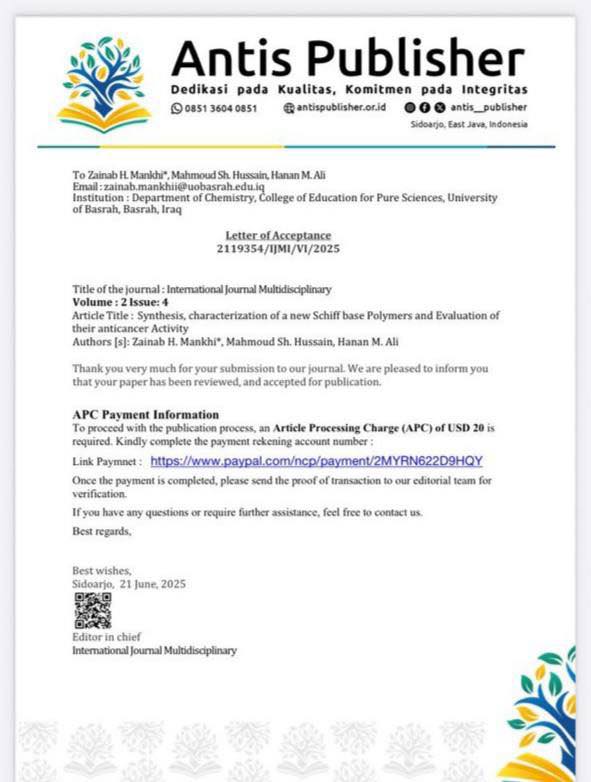 .
.
Important News



viewed most